Kerala Ayurvedic Treatments
The Living Tradition of Ayurveda in Kerala
Kerala has long been regarded as an important centre of Ayurvedic knowledge and practice. Among the three great Acharyas of Ayurveda, Vagbhata is traditionally associated with Kerala. His renowned classical treatise, Ashtanga Hridayam, remains one of the foundational texts of Ayurveda.
The term Ashtanga refers to the eight branches of Ayurveda: General Medicine (Kaya Chikitsa), Paediatrics (Kaumara Bhritya), Psychiatry (Bhuta Vidya), ENT and Ophthalmology (Shalakya Tantra), Surgery (Shalya Tantra), Toxicology (Agada Tantra), Geriatrics and Rejuvenation (Rasayana), and Reproductive Health and Vitality (Vajikarana).
Kerala has made a significant contribution to the preservation and practice of these classical Ayurvedic traditions. Over generations, this knowledge has evolved into what is now widely recognised around the world as Kerala Ayurvedic therapy and Kerala speciality treatments.
1. Podikkizhi
Podikkizhi is a traditional Ayurvedic treatment in which selected herbs are powdered according to the patient’s condition, made into bundles, warmed in suitable oil, and applied through massage. Depending on the patient, it may be performed with or without oil.
Podikkizhi works at deeper levels of the Dhatus (tissues), improving circulation and helping to liquefy deeply rooted Doshas. These are then carried towards the large intestine and eliminated through an appropriate Panchakarma procedure.
Podikkizhi can also be used as a Swedana (sudation) process. In severe Ama or toxic conditions, it may be performed without oil, and in certain conditions, even with sand.
The treatment is generally performed for 7 to 21 days, according to the physician’s advice, and is considered a Kapha-Vatahara treatment.
2. Elakkizhi
Elakkizhi is performed in a manner similar to Podikkizhi, but uses selected medicinal leaves instead of powdered herbs. The leaves are fried in suitable Vatahara oils and prepared into warm bundles for massage.
Himalayan rock salt, lemon, and coconut shavings are often added to the preparation. Compared with Podikkizhi, Elakkizhi acts at a relatively less deep level.
3. Pizhichil
Pizhichil is a traditional Ayurvedic therapy in which warm oil or other liquid medicines are poured over the body or a particular affected area by gently squeezing cloths soaked in the prescribed medicine.
Depending on the individual’s condition, the liquid medicines may be oil-based preparations, milk, herbal decoctions, or Dhanyamlam.
4. Uzhichil
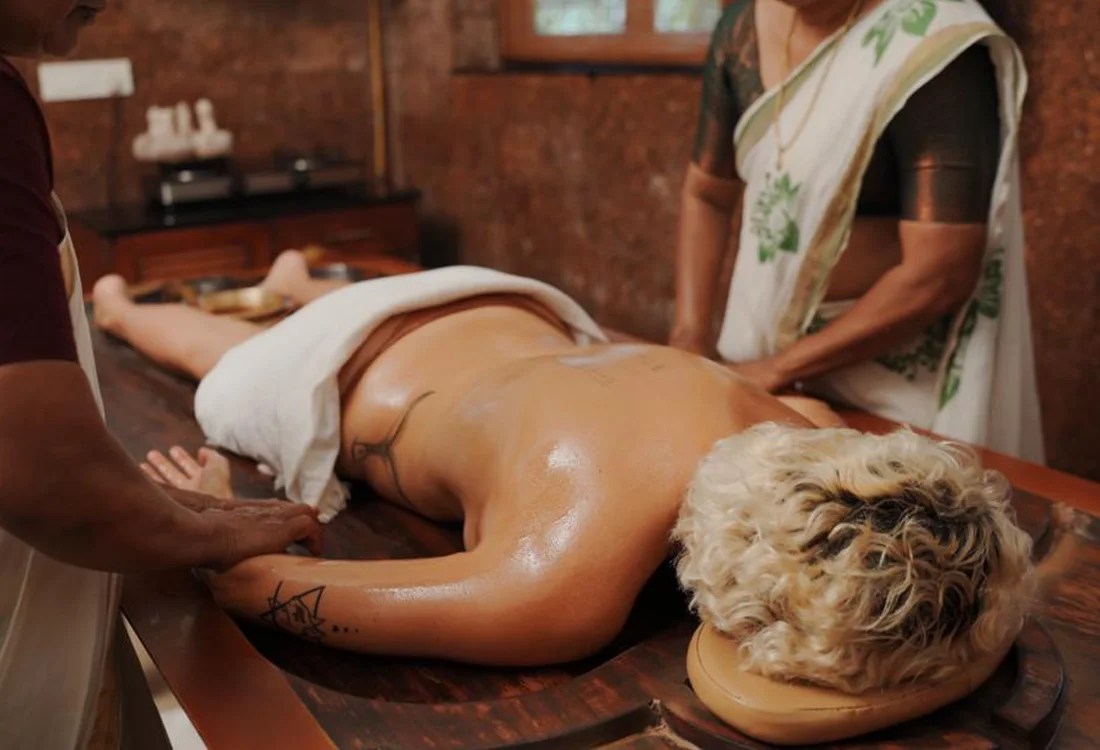
Uzhichil is a traditional Ayurvedic massage practised at Sreenilayam, usually during the last seven days of treatment. Unlike a fixed massage technique, Uzhichil is adapted to the individual and is traditionally believed to harmonise the flow of energy disturbed by illness and mental tension.
The five fingers represent the five basic elements of the body and universe, helping to restore harmony among these energies.
In uzhichil, we start it from the Mooladharam, awakening the kundalini Sakthy from there and circulating this energy all over the body and end the procedure at the Mooladharam in a positive way.
5.Navarakkizhi
Navarakkizhi is a highly rejuvenative Ayurvedic therapy using Navara, a special variety of rice with its brown husk. The rice is cooked in milk and a suitable herbal decoction, made into warm bundles, and gently massaged over the body.
Multiple masseuses may be involved to maintain warmth throughout the treatment. Traditionally, Navarakkizhi is used to nourish and strengthen the Dhatus (tissues) and is particularly valued in conditions involving wasting. In some cases, a paste prepared from Navara, milk, and herbal decoction may also be applied to the body.
Contact Us
Get in touch with Ayurvedam at Sreenilayam for more information about our Ayurvedic treatments.